 Kotor City Guide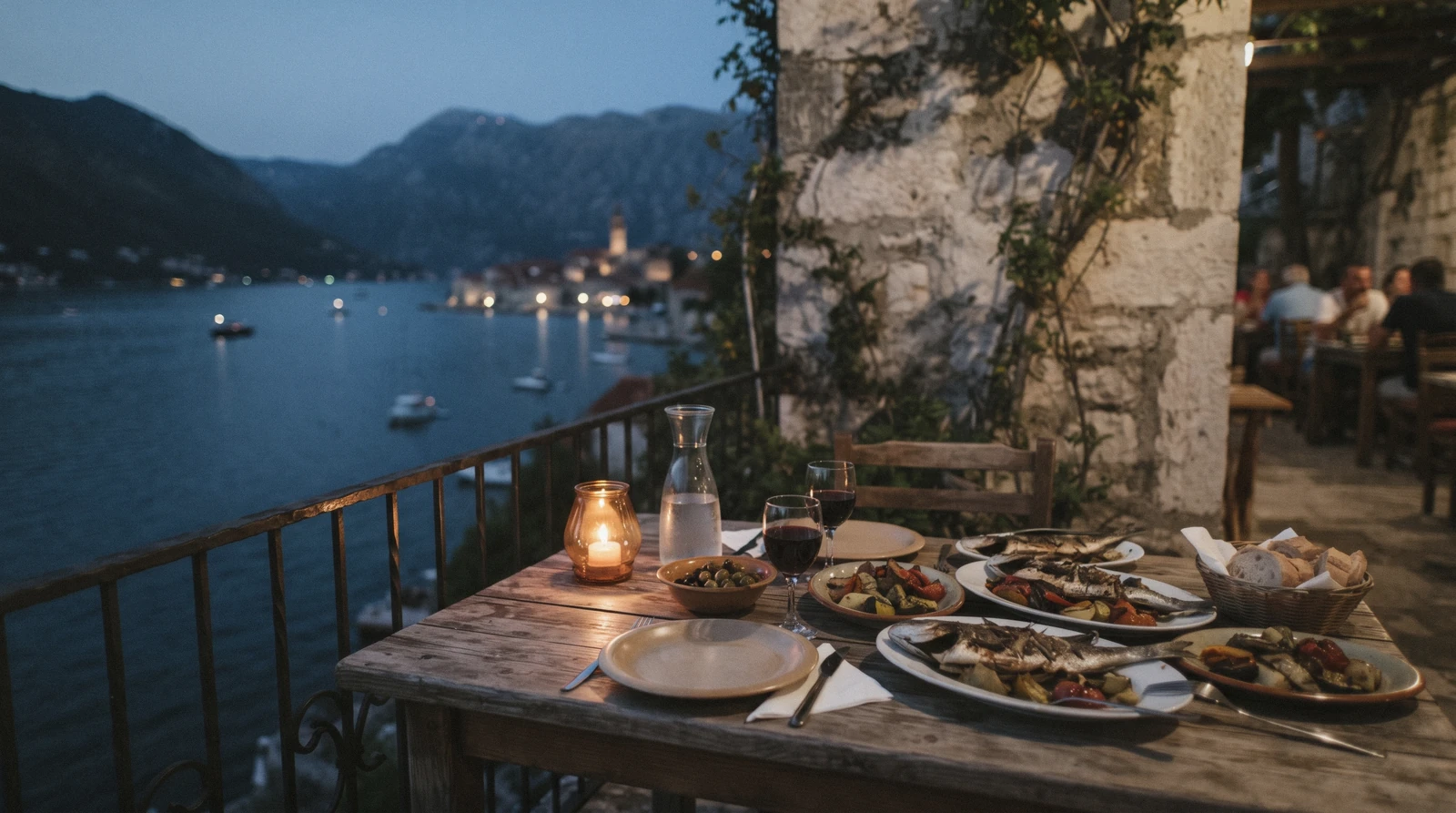
Where to Eat in Kotor: the Honest Guide to the Bay's Tables
Kotor restaurants divide by water: the tables on the quay, the lanes behind the square, and the tavernas up the mountain. Kotor eats well and eats cheaply by Western European standards, but it does not eat evenly. The square you walk into through the Sea Gate serves the cruise ships. The lanes behind it serve everybody else. Up the hill, in the village of Njeguši, family taverns smoke the ham the whole country eats. This page maps those tables honestly: what the bay cooks, where the crowds go and when to dodge them, and what nobody publishes. That last part matters. No citable restaurant ranking, no Michelin list, no Slow Food guide, covers Kotor at all. We name no venue on this page that no source vouches for. What we can do is price the town, time the crowds, explain the dishes and route you to the pages that list the tables in detail. Start with the quick answer, then the area comparison, then the dishes. The full guide lives on Kotor City Guide.
Quick answer The answer first, then the details that decide it
Eat one meal on the Square of Arms for the setting, then walk two lanes inland for the rest of your tables. The bay's kitchen runs on five things: Njeguški pršut, the dry-cured smoked ham from the mountain village, Njeguši cheese, crni rižot, the black risotto that is the Dalmatian cousin of the cuttlefish stews across the Adriatic, grilled fish from the bay itself, and kacamak, the mountain cornmeal dish that fuelled the herdsman's day. Wash it down with local wine and honey brandy, medovača. Montenegro uses the euro, so prices are painless to read, and English is widely spoken in the old town, where the tourist info point sits by the Sea Gate and on Arms Square. If you want a local to assemble the whole tasting for you, the Kotor food tour with a local guide is a private three-hour walk that ends fed and slightly fortified, and it is the operator Rick Steves recommends.
Kotor's Eating Areas Compared
Four areas own the town's tables. Each rewards a different kind of evening, and each has a different rule about booking and timing. The comparison tells you what you get and when to reserve.
| Area | What you get | When to book |
|---|---|---|
| Arms Square tourist belt | The postcard setting under the Clock Tower of 1602, menus in five languages, the highest prices in town, a table within sight of the Sea Gate | Book ahead in July and August, or eat early or late to dodge the cruise midday |
| The lanes behind the square | The old town's residential streets, smaller taverns, the black risotto and grilled fish the locals actually order, prices a step down from the square | Walk in, or book same day, the lanes hold fewer tables |
| Dobrota waterfront | Waterline terraces a short walk north along the bay, fish straight off the boat, sunset over the water, no walls and no crowds | Book on summer weekends, or arrive before 19:00 |
| Njeguši taverns on the mountain | The source itself, pršut aged in the village air, Njeguši cheese, kacamak, the 25-hairpin serpentine drive of 1881-1884 to get there | Not needed on weekdays, worth a call on summer Sundays, the serpentine takes 30-45 minutes from Kotor |
Figures current in Q3 2026.
The Eating Areas in Detail
Each area below gets its own honest paragraph, its practical line and its link out. Distances and driving times come from the route sources. Where no source gives a precise coordinate, we leave the pin out rather than guess.
old town
-
Arms Square and the tourist belt
old town square
The Sea Gate of 1555 opens straight onto the Square of Arms, and every arriving cruise passenger walks through it. The pier sits about 100 m from the walls, so the square fills within minutes of a ship docking. The restaurants ringing it sell the setting, the baroque Clock Tower built in 1602, the medieval pillory in front of it, the walls rising behind, and they price it accordingly. That is not a reason to skip the square. It is a reason to know what you are paying for. A table here at 20:00 in June, after the day boats have left and the heat has gone out of the stone, is one of the pleasantest seats on the Adriatic. The same table at 11:30 under two shiploads of day trippers is a different business. Read the menu, which is in English, because English is widely spoken in the old town, decide whether the view premium is worth it to you, and move on if it is not.
Tip: If you want the square without the crowd, check the cruise port ship schedule first and eat on a morning or a day when no ship calls. About 41 calls land in September, so quiet mornings exist even in high season.
-
The lanes behind the square
old town lanes
Only about 1,360 people live inside the walls, per the 2023 census, but the streets behind the two main squares are where their taverns sit, and where the town's cooking survives the cruise calendar. The lanes are pedestrian, stone-floored and a degree or two cooler than the open squares, and the menus shift toward the bay's real food, crni rižot, the black cuttlefish risotto, grilled fish from the bay, the mountain dishes. This is also where the food tour spends its three hours, because the tasting route of pršut, cheese, wine and honey brandy only works in the small family shops, not on the big square terraces. Prices in the lanes run a step below the square, though no official price list exists for Kotor restaurants at all, so treat any figure anyone quotes you as indicative. The lanes are a two-minute walk from anywhere in the walled town. Getting lost is the method. The old town guide maps the streets.
Tip: The tourist info point by the Sea Gate and on Arms Square can point you at the day's openings, and the whole old town is on our Kotor map if you would rather navigate before you set out.
Dobrota
-
The Dobrota waterfront
waterfront dining strip
Dobrota counts 7,345 residents, more than five times the population of the walled town, and its long waterfront north of the walls is where Kotor eats beside the water without selling tickets to do it. Stone quays and swimming slabs line the shore, the same calm, deep, clear bay water the town swims from, and the terraces face straight down the fjord. Grilled fish is the order here, because the boats land it nearby and the menu says so less theatrically than the old town's. The waterfront is a walk or a short drive from the walls, which filters out the cruise crowd entirely. Local buses along the bay leave from the bus station by the sea and will drop you partway along the strip if the evening is hot and the walk feels long.
Tip: Pair a Dobrota dinner with a swim off the quay before it, then read our beaches page for why the town has no sandy beach and which sandy ones sit within reach.
Lovćen
-
The Njeguši taverns on the mountain
mountain village taverns
Every dish this page describes has an address, and the address is Njeguši, the mountain village above the bay where Petar II Petrović-Njegoš, Montenegro's poet-prince, was born in 1813. The village air is the curing room. Njeguški pršut is dry-cured and wood-smoked ham aged there, eaten with Njeguši cheese and bread, and the family taverns on the main road run tastings of exactly that. Getting there is half the meal. The Kotor serpentine, built 1881-1884 under Austria-Hungary as a wagon and military route, carries 25 numbered 180-degree hairpins plus about 75 further turns, and takes 30-45 minutes from Kotor. It is narrow but paved, and a rental car is what opens it, Njeguši, Cetinje and Lovćen in one day. No source publishes the taverns' prices, so bring cash flexibility rather than a budget. The village page has the full story.
Tip: The combined ticket that covers Njegoš's birthplace in the village exists alongside the Cetinje museum tickets, about €20 ($22.82) reported, so a food lunch on the mountain can carry a museum afternoon with it.
Numbers match the list — tap a pin for the guide.
The Food Tour
One organised eating experience belongs on this page, because it is the only one that feeds you. Free cancellation up to 24 hours before the start. If you would rather build your own grazing evening, the area list above is the DIY version of the same route. The most expensive three hours on this site and the only one that feeds you dinner. Run by the operator Rick Steves sends people to, the route reads as a tasting menu of the bay's kitchen, from cured ham to honey brandy. It is a private group on foot, meeting in front of the Sea Gate, and the platform bills in your own currency.
The Dishes of the Bay
Five dishes own the Kotor table, and they split neatly into mountain food and bay food. From the mountain comes Njeguški pršut, the dry-cured, wood-smoked ham aged in Njeguši's air, served with Njeguši cheese and bread. It is the single most Montenegrin thing you can order, and the taverns on the village road age it themselves.
From the bay comes the fish. Grilled fish from the bay is the standard second course of every waterfront terrace, simply done, priced by the piece or the kilo depending on the house, and at its best in Dobrota where the boats work closest. Between the two sits crni rižot, the black risotto, the Dalmatian cousin of the cuttlefish stews across the Adriatic, coloured inky by the cuttlefish ink and rich rather than delicate.
It is a tavern dish, a shared-plate dish, and a good test of a kitchen. Kacamak is the mountain's other contribution, a cornmeal dish in the polenta family, built for herdsmen and long winters, and still on tavern menus as a side or a main with cheese and kaymak-style dairy. Order it once to understand what the mountains ate before tourism.
And then there is the sweet finish that is not a dessert at all, medovača, honey brandy, poured in small glasses at the end of a meal or as a welcome at the start of a tasting. No published menu prices exist for any of this in an official source, which is itself useful information. Kotor prices by negotiation with the menu in front of you, not by a citywide rate card.
A ballpark dinner budget, and how it fits a whole trip, lives on our costs page.
What to Drink in Kotor
Two drinks explain the bay's table. The first is wine. Montenegro's reds, led by the Vranac grape, are what the taverns pour by the glass and the carafe, and the food tour route includes wine among its stops alongside the ham and cheese, which tells you how central the pairing is.
Vranac is a big, dark, local red, and the honest advice is to drink it local rather than scanning the list for names you know from home. The second drink is the one that ends the meal. Medovača, honey brandy, is the bay's digestif, poured small, sweet and strong, and it appears twice on this page for a reason, once on the mountain where the honey comes from and once at the end of the food tour's route.
Beer and soft drinks are everywhere and unremarkable. Water from the tap is the standard cheap order. What no source publishes is any price list for drinks, so order the house wine by the carafe when a group is big enough and by the glass when it is not.
If wine tasting proper interests you, the mountain drive to Njeguši pairs a tavern tasting with the serpentine's 25 hairpins, and the Lovćen National Park road makes the same day into a full loop over to Cetinje.
The Cruise-Midday Rule
This is the single most useful thing this page can tell you. Kotor calls itself the third cruise destination in the Adriatic after Venice and Dubrovnik, the pier sits about 100 m from the old town walls, passengers walk 2-5 minutes to the Sea Gate, and ships dock rather than tender. That means the old town's restaurants absorb an entire ship's population in the space of a lunch service.
About 523 calls from roughly 85 ships are scheduled for 2026, so on many days the belt around Arms Square is effectively at capacity between late morning and mid afternoon. The rule is therefore simple. Do not eat your important meal between roughly 11:00 and 15:00 anywhere within sight of the Sea Gate on a ship day.
Eat early, eat late, eat inland in the lanes, or eat out of the walls entirely, in Dobrota or up the bay. The ships themselves must pass the 340-metre-wide Verige Strait to reach the pier, so arrival times slip when traffic stacks up, and the published schedule is a guide rather than a guarantee. Check the day's calls on our cruise port page before you plan a splurge lunch.
If you are the cruise passenger rather than the one avoiding them, the arithmetic runs the other way, the town empties beautifully once your ship's tour coaches leave, and the 15:00 table is the best table in town. Our shore excursion advice lives on the port page.
Eating on the Mountain, the Njeguši Day
The best food day in the bay is not in the bay. It starts with a drive or a ride up the serpentine, 25 numbered hairpins built between 1881 and 1884 as an Austro-Hungarian military route, 30-45 minutes from Kotor, with the town shrinking below you at every turn. At the top, in the village of Njeguši, the family taverns on the main road run pršut and cheese tastings, the ham smoked and aged in the same mountain air you are breathing, and the menus extend to kacamak and the rest of the mountain kitchen.
A combined ticket covers the poet-prince's birthplace in the village alongside Cetinje's museums, about €20 ($22.82) reported, so lunch can anchor a culture loop. From the village the road runs on to Cetinje, the historic capital, and up to the Lovćen National Park gate at €3 ($3.42) per person on recent gate reports, with the Njegoš Mausoleum at €8 ($9.13) adult and €4 ($4.56) child. A rental car is what opens this whole day, the serpentine is narrow but paved, and parking inside Kotor's walls does not exist, so use the lots outside.
If you would rather not drive the hairpins yourself, two organised versions exist. The cable car, Njeguši and Cetinje day tour rides the gondola up and the road down, and the hop-on hop-off bus with walking tour runs the serpentine viewpoints from town every 20-25 minutes for US$32. Either way, time the tavern lunch for the middle of the day and book nothing, because the village tables turn over with tour groups in waves and are quiet between them.
Why This Page Names No Restaurants
An honest guide has to say this plainly. No citable restaurant ranking covers Kotor. No Michelin list, no Slow Food guide, no Gambero Rosso, none of the recognisable arbiters of quality has published a Kotor selection, and the food blog landscape is a layer of affiliate roundups rather than a source we can verify.
Our rule is therefore that we name venues only when a venue's own site or a genuinely published list vouches for it, and in this run of research nothing cleared that bar for the old town tables. That is a negative finding, and it is content, because it tells you how to read every 'top 10 restaurants in Kotor' page on the internet, this site's detailed listing included. Treat such lists as shortlists to check against menus on the door, not as verdicts.
What we can verify, and what this page therefore commits to, is the food itself, the five dishes the bay's taverns cook, the geography of the four eating areas, the cruise timetable that governs the crowds, and the one eating experience sold with a published operator, price and review record, the private food tour at 4.9 stars across 59 reviews. For the venue-level detail that does pass our sourcing bar, the tables we can name and why, our best restaurants page carries the list, and our food tour page reviews the guided version.
Plan the Rest of the Trip
Eating is one column of the plan. The things to do hub owns the days, the tours hub owns the boats and the mountains, and the itineraries sequence both, from a single day in Kotor to a three-day loop that leaves room for a long Njeguši lunch. Sleep near the tables you want, inside the walls or on the Dobrota waterfront, with our where to stay hub and its hotel and apartment pages. The practical layer, the weather that decides terrace season, the best time to visit, the getting around basics, all sit one click away.
Where to Eat in Kotor, Frequently Asked Questions
What food is Kotor known for?
Five things, per the bay's own kitchen. Njeguški pršut, the dry-cured wood-smoked ham from the mountain village of Njeguši, eaten with Njeguši cheese. Crni rižot, the black cuttlefish risotto that is the Dalmatian cousin of the stews across the Adriatic. Grilled fish from the bay itself. Kacamak, the mountain cornmeal dish. And medovača, honey brandy, to finish. The food tour route reads as a tasting menu of exactly these.
Where should I eat in Kotor old town?
Split the answer in two. The Square of Arms inside the Sea Gate sells the setting and prices it, and is best at 20:00 rather than at cruise midday. The lanes behind the square hold the smaller taverns where the bay's food actually lives, a two-minute walk from anywhere in the walls. Our best restaurants page names the tables that pass our sourcing bar.
Is Kotor good for seafood?
Yes, with one honest caveat. The bay is a working ria about 28 km long, and grilled fish from the bay is the standard order on every waterfront terrace, at its most straightforward in Dobrota. The caveat is that no independent source grades the fish, so judge the menu on the door and the fish on display rather than any ranking.
What wine does Montenegro drink?
Local reds led by the Vranac grape are the tavern pour, by the glass or the carafe, and wine features on the food tour route alongside the ham and cheese. Drink it local rather than hunting for familiar labels. Honey brandy, medovača, is the small glass that ends the meal.
Do Kotor restaurants take cards?
Not stated in any source we could check, and that uncertainty itself is the useful fact. Montenegro uses the euro unilaterally, though it is not a eurozone member, so cash is the safe default for small taverns and mountain stops. Several bay sights are explicitly cash only, including the €5 ($5.71) island admission at Our Lady of the Rocks and the €3-5 ($3.42-5.71) church museum in Perast, so carry euros beyond the old town.
Prices, hours and terms are set by the venue or operator and confirmed at checkout.
We may earn a commission if you book through one of our links, at no extra cost to you. Full affiliate disclosure