 Kotor City Guide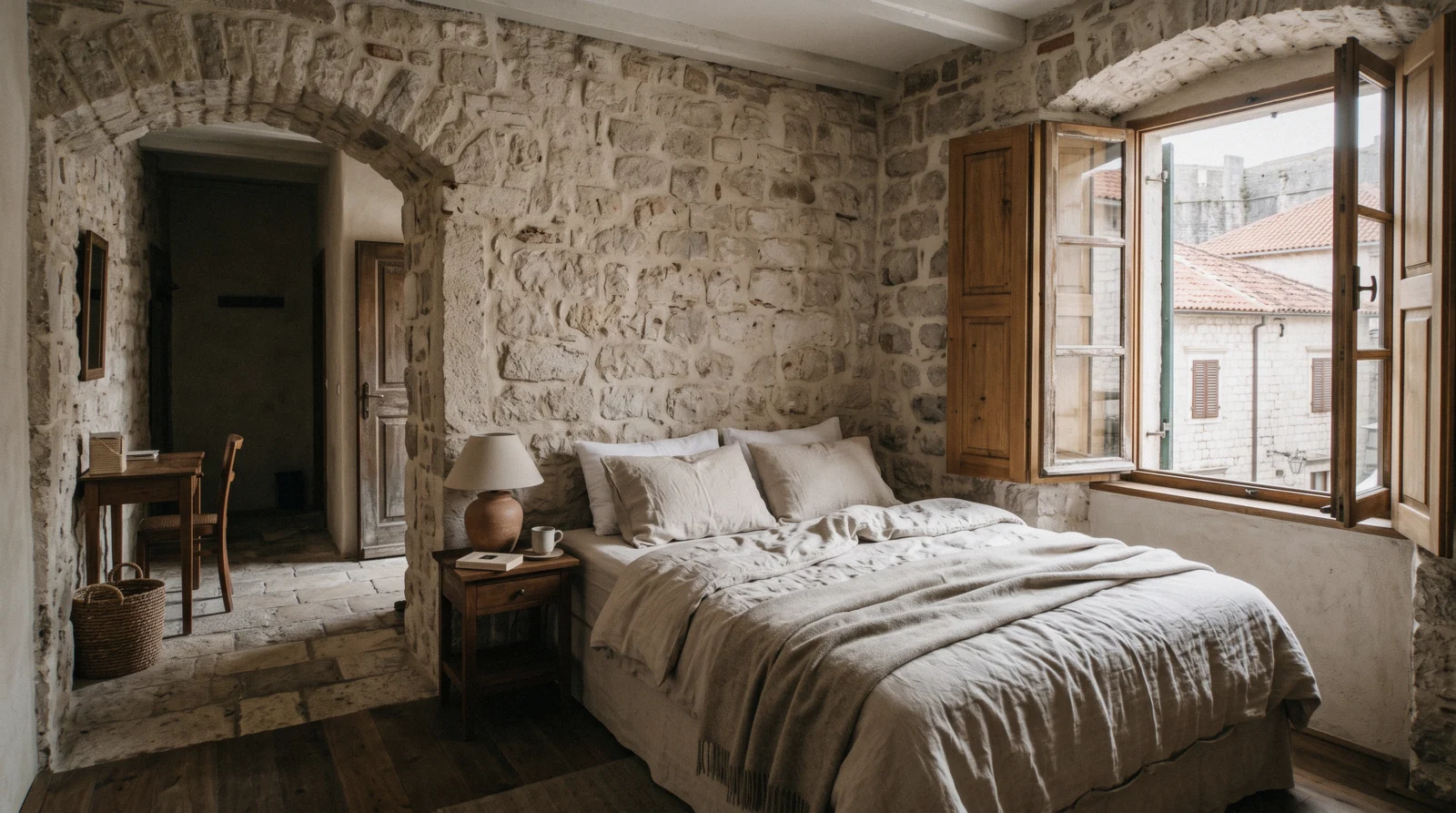
Hotels in Kotor: What You Get at Each Tier of Town
Hotels in Kotor divide by geography before they divide by stars. Kotor hotels Kotor is not one hotel market. It is five or six, and they sell different things. A room inside the walls sells atmosphere and costs you your car. A room on the Dobrota waterfront sells the water and a morning walk to the gate. Škaljari sells parking and lower rates. Prčanj and Orahovac sell quiet and a swim before breakfast. Tivat sells the marina and a short run to the airport. None of these claims needs a marketing budget, because the geography does the work. This page walks each tier, states plainly what it buys and what it costs you, and hands you off to the pages that own the bookings and the rest of the trip. One honest limit up front. No official source publishes a nightly-rate table for Kotor accommodation, and we will not invent one. What we can do, and what actually matters when you choose, is the shape of the town: which base puts you where, what it does to your luggage, your parking and your sleep. Rates you can check on any booking site in two minutes. A wrong base you only discover at midnight with a suitcase on cobbles. Montenegro uses the euro, unilaterally and outside the eurozone, so every rate you see is in euros. English is widely spoken in the old town, and the tourist info point sits by the Sea Gate and on Arms Square if you arrive with questions before you check in. The full guide lives on Kotor City Guide.
Quick Answer
Which Kotor hotel tier is right for you
If you want the postcard and you travel light, book inside the walled town and accept stairs, noise and no parking. If you want water at your feet and an easy walk to the walls, book the Dobrota waterfront. If you arrive by car or care about the rate, book Škaljari or the upper town.
If you want quiet, swimming and village calm, book Prčanj or Orahovac along the bay. If you fly late, want a marina promenade or a big resort scale, book Tivat. The full comparison sits in the table further down the page, and the where to stay hub carries the shortlist cards for each area.
Inside the Walled Town: Boutique Rooms in the Stone
What you get
The old town is the reason most people come. It has been on the UNESCO World Heritage list since 1979, and Venice shaped it across nearly four centuries of rule. Sleeping inside it means stepping out of your door into lanes that run from the Sea Gate of 1555 up past the Clock Tower of 1602 to St Luke's church of 1195. The small hotels here sit in former stone palazzi, and the better ones trade on high ceilings, thick walls and a courtyard. Only about 1,360 people actually live inside the walls, so at night, after the day visitors leave, the town belongs to the people sleeping in it. That is the product. You are paying for the hours between seven in the evening and ten the next morning.
What you get with it: everything walkable. The city walls gate, the cathedral of St Tryphon, the Maritime Museum, the square cafes and the start of any walking tour are all minutes away on foot. The old town guide covers the sights in detail. Evening is when the town is best, and the things to do after dark page starts from an old-town bed.
What it costs you
Parking inside the walls does not exist. The old town is fully pedestrian, and cars use the lots outside the walls, so a car-based trip means dragging bags from a lot to your door over cobbles. Rooms above bars and restaurants hear the noise, especially on cruise-call evenings and summer weekends.
Luggage on wheels hates this town. And small buildings mean small rooms, occasional weak air conditioning and stairs that no lift was ever retrofitted to serve. Ask any property about room location and floor before you book, not after.
Who this tier suits
Couples on a short break, first-time visitors, anyone arriving by bus or transfer rather than car, and travellers who value the evening and early morning town more than space and silence. If that is you, the best hotels in Kotor page carries the named shortlist. If you want the same location cheaper and with a kitchen, apartments inside the walls do the same job, and the apartments page sorts them out.
Backpackers should look at the hostel page instead, because dorm beds inside the walls are the cheapest legal way to sleep in the UNESCO zone.
The Dobrota Waterfront: Sea at the Door, Walls in Walking Distance
What you get
Dobrota is the residential stretch that runs north along the water from the old town. The 2023 census counted 7,345 people there, which tells you it is a real neighbourhood and not a hotel strip. Hotels and guesthouses line the shore road, many with their own stone swimming platforms straight onto the bay. Kotor town itself has no sandy beach. Swimming along Kotor and Dobrota happens off slabs and quays into calm, deep, clear water, so a hotel with its own platform is the comfortable version of that. Sea access is the whole pitch of this tier, and it delivers.
The walk into town along the waterfront is the pleasant commute in Montenegro. In the evening it takes you past lit palazzi with the fortress walls glowing above. You get the old town when you want it and escape from it when you are done, which the walled-town tier cannot offer.
What it costs you
Distance, modestly. You are a walk or a short drive from the walls, so a spontaneous midday return to the room is less easy, and in summer heat the walk back at midday earns its reputation. The shore road carries traffic in season, so a sea-facing room can hear it.
Parking is easier than in the walled town but not guaranteed at every property, so confirm it. And water entry is deep off the slabs, with no shallow shelf. No official source mentions lifeguards at the Kotor-side swimming spots, so treat the water accordingly, and read the beaches page for the sandy alternatives across the bay.
Who this tier suits
Swimmers, returners who have already done the old-town room, families who want a platform rather than a beach, and anyone driving who still wants to reach the walls on foot. Dobrota is the all-round pick in this town and the one we would hand a first-time visitor who rents a car.
Škaljari and the Upper Town: Parking and Prices
What you get
Škaljari is the district that climbs the hillside behind the old town, and the upper town spreads along the road inland. The census counted 3,342 residents in Skaljari, again a real neighbourhood. The practical selling points are the two that the walled town cannot give: parking that exists, and rates that run lower for the same star of comfort.
Rooms here are ordinary apartments and guesthouses, not palazzi, but they are bigger, quieter at night and easier to load and unload. The Vrmac tunnel and the inland road toward the highway start here, which makes this the natural base if your days are drives: Budva, Lovćen, Cetinje, Njeguši.
What it costs you
You lose the water and the postcard. Views from the upper streets can be good, since the hillside looks down over the roofs, but you will drive or walk down to the bay for almost everything. The walk down is fine, the walk back up is a hill, and in August you will take a taxi.
The lower station of the Kotor cable car sits at Dub above Skaljari, which is a genuine bonus for this tier. If you are driving a rental, read the car rental page and note again that parking inside the walls does not exist anywhere, so the lots outside are your reality whatever you book.
Who this tier suits
Road trippers, families with a car full of gear, longer stays where the nightly rate compounds, and travellers who plan day drives and want the highway on the wrong side of the tunnel rather than through town.
Prčanj and Orahovac: Quiet and Water on the Far Shore Road
What you get
Follow the bay shore west from Dobrota and you reach Prčanj, then Orahovac, two stone villages of former sea-captain houses strung along the water. Both appear on the standard list of the bay's well-preserved towns alongside Kotor, Perast and Tivat. Hotels here are few, small and waterfront, often conversions of those captain houses.
The product is quiet and water: swim off the quay in the morning, hear nothing but the bay, eat at the village konoba. The shoreline runs 107.3 kilometres around this fjord, and this stretch is its calmest face. It is also the correct base if your plan is kayaking the bay or just doing very little.
What it costs you
Every evening out becomes a drive or a long walk back, because Kotor is a few kilometres up the coast road and buses along the bay are thin after dark. Dinner in the village instead of the old town most nights is the deal you sign. There is no sightseeing in the villages themselves beyond the houses and the water, so this tier only works if you have already seen the bay or plan a slow one.
The bay of Kotor and Perast pages cover what the rest of the water offers.
Who this tier suits
Second-time visitors, couples on a slow week, remote workers, and anyone whose idea of a holiday in this region is a platform, a book and a short drive to dinner in town twice rather than every night.
Tivat: Marina Scale and the Airport Run
What you get
Tivat sits across the hill from Kotor on the other small bay, and it plays a different game. Its marina quarter is the biggest-scale accommodation in the area, modern waterfront buildings, promenade restaurants and a groomed seafront that the old town deliberately is not. Tivat Airport is about 5 kilometres from Kotor by road, and it is in Tivat, so sleeping there shortens the arrival and departure day to minutes.
About 25 airlines fly from Tivat in 2026, including easyJet, Jet2, Lufthansa, Air France and Turkish Airlines, with new summer routes announced. The town is also the boarding point for the full-day bay cruise on the big covered ship, and for some minivan departures of the day tours.
What it costs you
You are not in Kotor. The drive around the hill or the tunnel takes time in season traffic, and the walled town becomes a planned outing rather than your street. If Kotor itself is the point of the trip, a Tivat bed dilutes it.
The Tivat airport page covers the transfer options in detail. If you would rather land and be in the old town by dark, book the airport transfer and stay in Kotor instead.
Who this tier suits
Travellers who want modern hotel stock, a promenade and moored yachts, families splitting a large waterfront apartment, and anyone with an awkward flight time who values the short airport run above location.
Mountain Guesthouses Toward Njeguši
What you get
The fourth tier is vertical rather than horizontal. Over the serpentine from Kotor, the village of Njeguši sits in the mountain air that dry-cures the famous Njeguški pršut, the wood-smoked ham served with Njeguši cheese in family taverns along the main road. Guesthouses up here are few, family-run and cheap by coast standards, and the reward is a Montenegro most visitors only photograph from the road.
The serpentine itself was built 1881 to 1884 under Austria-Hungary as a wagon and military route and carries 25 numbered hairpins plus about 75 further turns, taking 30 to 45 minutes from Kotor. A bed in Njeguši puts you at the top of it, above the summer haze, with Lovćen's mausoleum and Cetinje an easy drive instead of a switchback climb. Njegoš, the poet-prince buried in that mausoleum, was born in the village, and a combined ticket covers his birthplace.
What it costs you
A car is not optional. The serpentine is narrow but paved, and the same 25 hairpins you enjoy on the way down are work at night after dinner wine. Mountain evenings run cool even when the bay swelters, and village dinner options are taverns, not a town.
The road is also the tour bus route, so midday sees traffic. If the mountains are your priority but a village bed is not, the cable car, Njeguši and Cetinje day tour covers the same ground from a Kotor base.
Who this tier suits
Hikers, drivers, photographers chasing morning light over the bay from above, and travellers on a Montenegro loop rather than a Kotor holiday.
Tier by Tier: What You Actually Buy
The comparison table
| Tier | What the tier buys | What the tier costs you | Who it suits |
|---|---|---|---|
| Inside the walled town | Atmosphere, stone palazzi, everything on foot, the evening and early morning town | No parking at all, stairs, noise above bars, luggage over cobbles, small rooms | Couples, first-timers, arrivals by transfer |
| Dobrota waterfront | Sea access off slabs and platforms, the waterfront walk to the walls, easier parking | A walk or short drive to town, road noise in season, deep water entry | Swimmers, drivers, all-round first pick |
| Škaljari and upper town | Parking, lower rates, bigger rooms, quick road and tunnel access, cable car station above | No water, a hill to climb home, driving or taxiing down for evenings | Road trippers, families with gear, longer stays |
| Prčanj and Orahovac | Quiet, village calm, swimming off the quay, captain-house character | A drive to every evening out, no sights in the village itself | Slow stays, returners, remote workers |
| Tivat | Marina scale, modern buildings, minutes from the airport, promenade evenings | Not in Kotor, season traffic between you and the walls | Resort travellers, awkward flights, big apartments |
| Njeguši and the mountain | Mountain air, the serpentine at your door, Lovćen and Cetinje close, village prices | A car is required, cool evenings, tavern-only dinners | Hikers, drivers, Montenegro loops |
Tiers describe what the town's stock offers. no source publishes rate bands. Figures current in Q3 2026.
The Booking Calendar
When the rooms go
Two forces empty Kotor's beds, and both are predictable. The first is the season. July and August are the full-price, book-early months, when average highs sit near 29.7 degrees and every family in the region is on the coast. The second is the cruise calendar, and it is the one people underestimate. The port calls itself the third cruise destination in the Adriatic after Venice and Dubrovnik, about 523 calls from roughly 85 ships are scheduled for 2026, and the pier stands about 100 metres from the walls, so a call day floods the old town with day visitors from morning to late afternoon. Cruise days cluster on weekends and fill the walled-town rooms first, since those guests want exactly the location the ships deliver the crowds to. The cruise port page explains the schedule mechanics, and when to visit weighs the trade-offs month by month.
The practical pattern: book July and August as early as you tolerate, book the walled town before the Dobrota waterfront because it has fewer rooms to begin with, and if your dates are September, know that about 41 cruise calls land that month, so still check the port schedule for your specific nights. May, early June and October are the softer market, when waiting costs you less.
Tax and Check-In Realities
The residence tax
Montenegro charges a residence tax of €1.00 ($1.14) per person per night, halved for ages 12 to 18 and waived under 12. Your accommodation collects it, so expect it either folded into the rate or taken separately at check-in, and ask which when you book so the bill is not a surprise. If you stay in a private apartment or room rather than a licensed hotel, the rule is different: your host should register you, and private-stay guests register at the tourist organisation within 24 hours.
This is a genuine, sourced rule from the Tivat tourism organisation, and it is the only accommodation fee with an official published figure. Our costs page puts it in the context of the whole trip budget.
Checking in
Small Kotor properties are often family-run, which means reception hours rather than a 24-hour desk. If your flight lands late, confirm how you collect keys before you fly rather than standing outside a dark door at midnight. Late landings are common here because Tivat receives evening rotations in season.
For that case we carry a card for the private airport transfer, a door-to-door van whose driver waits in arrivals with a name sign and whose price is fixed before you fly at US$66.38 per vehicle, billed in your own currency by the platform and rated 5 stars by 147 reviewers. Priced per vehicle for up to 8, it divides well for three or more travellers. The Tivat airport page compares it with taxis and shuttles, and getting around Kotor takes over once you are in town, where the old town is fully pedestrian and cars park at lots outside the walls.
What nobody publishes
It is worth saying what is missing, because it changes how you should read hotel listings here. No official nightly-rate table exists for Kotor. No source publishes floor plans that tell you whether your boutique room is above a bar.
Nothing official lists which walled-town properties have air conditioning adequate for a 29-degree August night. The honest response is to ask properties direct questions before booking, to read the recent reviews for noise and heat mentions, and to treat any guide that prints tidy rate bands for this town as decoration. The geography in this page is verifiable.
The rates are yours to check live.
Arriving Late? Book the Transfer In
One card belongs on this page, because the transfer decides whether your first hotel night starts well. A private V-class van between Tivat or Podgorica airport and Kotor, Budva, Tivat or Perast. The driver meets you in arrivals with a name sign and tracks your flight. Priced per vehicle at US$66.38 for up to 8, so it divides well for a group. Free cancellation 24 hours before pickup.
Nearby Pages
Where the rest of the decision and the rest of the trip live.
Kotor Hotels: Questions
Do Kotor hotels have parking?
Inside the walled town, no. The old town is fully pedestrian and cars use the lots outside the walls, so a walled-town booking means hauling bags over cobbles from a lot. The Dobrota waterfront and Škaljari offer parking far more readily, which is a core part of what those tiers sell. Always confirm parking with the specific property before booking, and see our guide to getting around Kotor for how the town handles cars.
Are there hotels inside Kotor old town?
Yes, small hotels and boutique properties operate inside the walls, many converted from stone palazzi, and they are the atmospheric heart of Kotor's accommodation. Only about 1,360 people live inside the old town itself, so the stock is limited and the buildings are old, which means stairs, compact rooms and no parking. Once the day visitors leave, guests there have the UNESCO streets to themselves.
When should I book a Kotor hotel?
July and August book out first and command the top rates, so lock those as early as you can. Cruise days matter too, since the port expects about 523 calls from roughly 85 ships in 2026 and a call day fills the town. Weekend cruise days tighten the walled-town rooms in particular. May, early June and October are the forgiving months. Our best time to visit page walks the trade-offs.
Is there a resort near Kotor?
The large-scale, resort-style accommodation in this part of the bay sits in Tivat, whose marina quarter carries modern waterfront hotels and promenade dining. Kotor town itself, and the bay villages of Prčanj and Orahovac, run to small hotels, guesthouses and apartments rather than resort compounds. Tivat Airport is about 5 km from Kotor, so a Tivat base also shortens the airport run at the cost of not sleeping in the walled town.
Do Kotor hotels include the residence tax?
Montenegro charges a residence tax of €1.00 ($1.14) per person per night, half for ages 12 to 18 and free under 12. Your accommodation collects it, but whether it sits inside the quoted rate or is added at check-in depends on the property, so ask when booking. Guests in private rooms and apartments must be registered, with private-stay guests registering at the tourist organisation within 24 hours. Our costs page sets it in the full trip budget.
Can I stay on the water in Kotor?
Yes, and you should be clear what that means. Kotor town has no sandy beach, and swimming along Kotor and Dobrota happens off stone slabs and quays into calm, deep, clear water, so waterfront hotels there offer sea access rather than a beach. The sandy beaches people search for, such as Trsteno and Plavi Horizonti on the Tivat side and Jaz toward Budva, sit outside town. Our beaches page covers them.
Prices, hours and terms are set by the venue or operator and confirmed at checkout.
We may earn a commission if you book through one of our links, at no extra cost to you. Full affiliate disclosure