 Kotor City Guide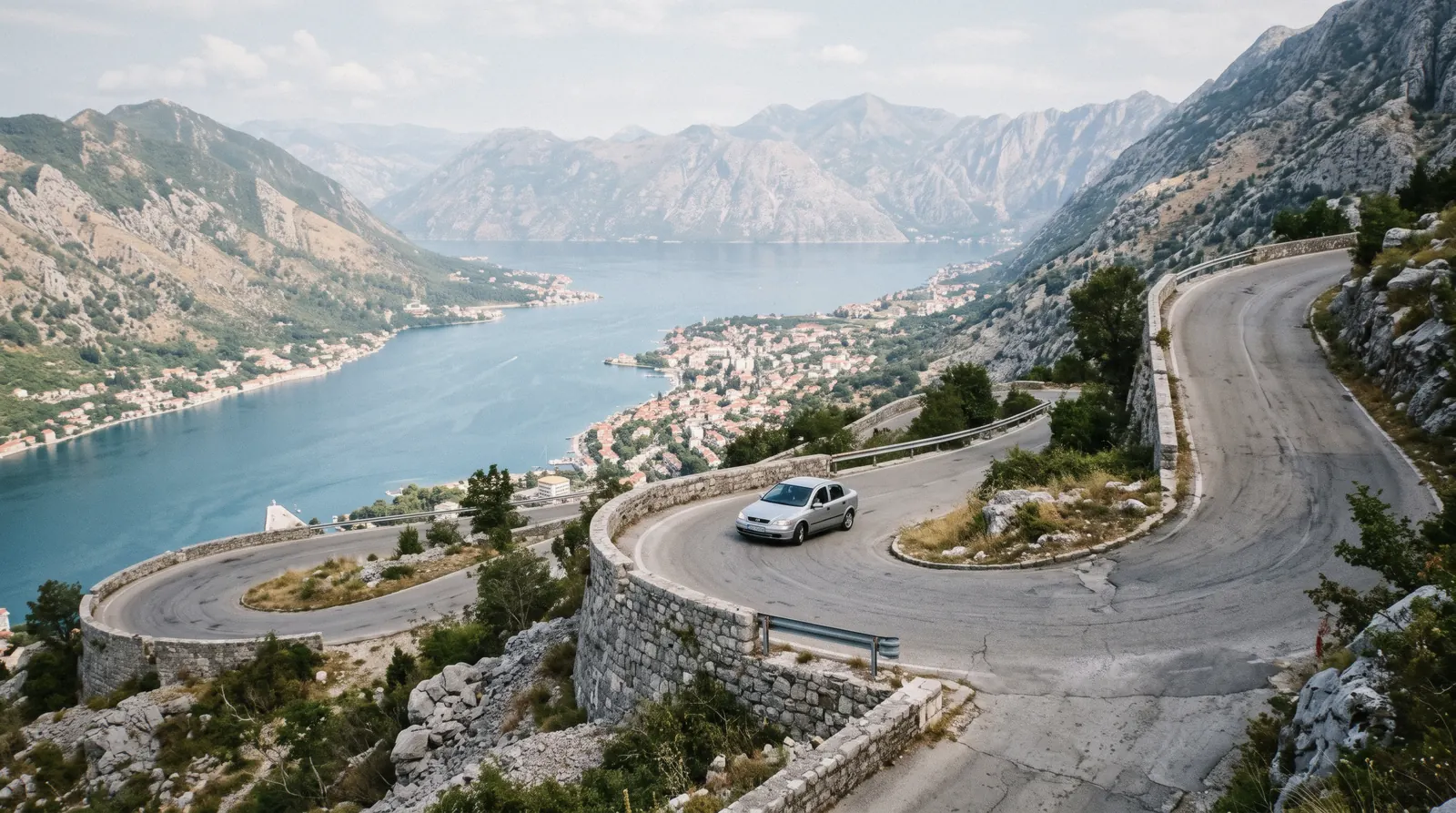
Renting a Car in Kotor: What the Roads Decide for You
A Kotor car rental decides what your trip can reach. Kotor is the wrong town for a car and the right base for one. Inside the walls, the old town is fully pedestrian and parking does not exist. Outside the walls, a car is the only thing that opens Njeguši, Cetinje and Lovćen in one day, and the only sane way to reach the sand beaches on the Tivat side or push north to Durmitor. This page answers the question the roads decide: what a car opens, what it costs, where the agencies sit, what documents you need for the Dubrovnik run, and when a tour or a bus beats you behind the wheel. If you land late and only need the airport leg, skip straight to the transfer option at the bottom. For the town without a car, our getting around Kotor guide covers buses and taxis. Everything else on this page is about driving. The full guide lives on Kotor City Guide.
Quick answer The answer first, then the details that decide it
Rent a car in Kotor if you want the mountain triangle of Njeguši, Cetinje and Lovćen, the beaches outside town, or a Dubrovnik run on your own clock. Do not rent one for the town itself: the old town is pedestrian, cars sit in lots outside the walls, and the bay's headline sights are better reached by boat. The serpentine to Njeguši is narrow but paved and any small car handles it. Montenegro uses the euro, unilaterally and outside the eurozone, so prices read the same as at home for euro visitors. A private airport transfer is the middle path: arrive by van, rent only for the days you drive.
Kotor itself needs no car. The walls, the cathedral, the museums and the squares sit inside a few hundred metres of stone. What the car buys you is the country behind the town, and that country is exactly why most people rent.
The classic day is the mountain triangle. The Kotor serpentine climbs from the town edge toward Lovćen: 25 numbered 180-degree hairpins plus about 75 further turns, built between 1881 and 1884 under Austria-Hungary as a wagon and military route. Thirty to forty-five minutes of climbing puts you at the top, where the village of Njeguši waits with its dry-cured, wood-smoked pršut and Njeguši cheese served in family taverns along the main road. From there the road runs on to Cetinje, Montenegro's historic capital since Ivan Crnojević founded it, with the castle of 1482 and the monastery of 1484, now on the UNESCO tentative list. Add the Lovćen National Park gate and the Njegoš Mausoleum on Jezerski vrh and you have the single best driving day in the region.
The second day the car earns its keep is the beach run. Kotor town has no sandy beach, only stone slabs and quays along the Kotor and Dobrota waterfront with deep water and no shallow entry. The sand people mean when they search sits outside town: Trsteno and Plavi Horizonti on the Tivat side, Jaz on the road toward Budva. Our Kotor beaches guide maps them. No official source mentions lifeguards at the Kotor-side spots, so swim with that in mind.
The third is the brave one: Durmitor National Park and the Tara canyon. It is drivable but it is a long day on mountain roads, and most visitors hand it to a tour instead. The full loop with the gorge, the 1940 Đurđevića Tara bridge and Black Lake works far better as an overnight in Žabljak if you drive it yourself.
Nearby by car but not worth one: Budva is a short coast-road run down the Adriatic highway, and buses run through the day, so see our Kotor to Budva page before you reach for the keys.
Here is the day a rental car exists for, with the numbers at each gate.
The serpentine to Njeguši. The road leaves Kotor and climbs 25 numbered hairpins toward the Krstac ridge. It is narrow but paved. Allow 30 to 45 minutes from Kotor to hairpin 25. Drive it early: tour vans and cyclists share the same corners, and the hop-on bus runs the viewpoints every 20 to 25 minutes through the day. If you would rather not drive it at all, the hop-on hop-off bus with walking tour rides the same corners, and the 25-turns downhill bike ride lets the cable car do the climbing. Our Njeguši guide covers the village in full.
Njeguši village. This is the birthplace of Petar II Petrović-Njegoš, Montenegro's poet-prince, and a combined ticket covers the house with the museum sites. The practical reason to stop is the food: family taverns on the main road run tastings of pršut smoked in the village's mountain air, with Njeguši cheese and bread. Cash helps. Budget 45 minutes to an hour.
Cetinje. The historic capital, founded in the 1480s, holds the Museum of King Nikola in the royal palace built 1863 to 1867, about €8 ($9.13) on the official list with €4 ($4.56) for pupils and students, and the Cetinje monastery, rebuilt in 1701, which keeps the right hand of St John the Baptist and a particle of the True Cross. A combined Cetinje museums plus mausoleum ticket runs about €20 ($22.82) reported. Museums open roughly 09:00 to 17:00. Parking in Cetinje is easy compared with Kotor. Details on our Cetinje page.
Lovćen National Park and the mausoleum. The park gate charges about €3 ($3.42) per person on recent visitor reports, and the Njegoš Mausoleum is €8 ($9.13) adult, €4 ($4.56) child or student. From the upper parking at Jezerski vrh, 461 steps climb to the mausoleum, where Ivan Meštrović's giant caryatids flank the seated figure of Njegoš and the view runs from the Bay of Kotor to the Montenegrin highlands. Hours run about 09:00 to 18:00 in the summer season, mid-April to mid-November. From 16 November to 10 April the National Museum closes it. These are gate reports because the official parks price list was unreachable when we checked. Full route on our Lovćen National Park page.
If that whole triangle sounds like someone else's problem, the Lovćen cable car, Njeguši and Cetinje day tour runs the same ground by minivan in seven and a half hours, and the Great Montenegro tour with Lovćen, mausoleum and Sveti Stefan stretches it to eleven hours with the coast added. Note the Great Montenegro price excludes about €16 ($18.26) in cash entrance fees, which changes the comparison with driving yourself.
Three costs decide how happy your rental makes you, and none of them is the daily rate.
Parking inside the walls does not exist. Kotor's old town is fully pedestrian and there is no way around that. Every visitor parks in the lots outside the walls and walks in. Our Kotor map shows the town layout. No official source publishes a parking price list for Kotor, so we print no figure. If you stay inside the walls, our where to stay guide explains the trade: atmosphere and stairs inside, parking and lower prices in Škaljari and the upper town.
The serpentine is narrow. Paved, engineered in the 1880s for wagons, and today shared with buses and bicycles. Any small car handles it. Take it in low gear on the way down, use the passing bays, and do not stop in the corner. The upper section toward the mausoleum is the same story at altitude.
Summer traffic is real. July and August bring queues at the Debeli Brijeg border toward Dubrovnik that can add 30 minutes to 3 hours each way, and the coast road toward Budva crawls on beach days. In town, cruise days stack pedestrians at the Sea Gate. About 523 cruise calls are scheduled through 2026, and the pier sits about 100 m from the walls, so the old town absorbs them in minutes while the roads absorb the coaches.
Documents and borders. For the Dubrovnik run, about 1h45 of driving plus the Debeli Brijeg and Karasovići crossings, you need your passport, the rental papers, and the agency's explicit permission to take the car into Croatia and Bosnia. Ask at booking, not at the border. Montenegro is outside the EU, so the crossing is a real border. Our Dubrovnik to Kotor page covers the route in both directions. Montenegro uses the euro unilaterally, so you carry one currency for the whole trip.
Where agencies sit. Rental desks cluster in Kotor town, at Tivat Airport about 5 km away, and at Podgorica Airport about 65 km out. We name no specific agency here because no source in our research names one, and we do not invent names. Compare live prices on the aggregators, then check two things before you book: the cross-border permission and the fuel policy. For the airport leg itself, see our Tivat Airport and Podgorica Airport pages.
Compared
The options, priced side by side.
| Trip | Rental car | Tour | Bus or boat |
|---|---|---|---|
| Njeguši, Cetinje, Lovćen in one day | Best option. Paved serpentine, 30-45 min to hairpin 25, gates about €3 plus €8 mausoleum | Minivan day tours run the same loop in 7.5-11 hours | Hop-on bus covers the serpentine viewpoints only |
| Blue Cave and Our Lady of the Rocks | Useless, boat-only access | Speedboat circuit US$63, 3 hours | Water taxi at Perast quay about €5 return plus island admission €5 |
| Beaches on the Tivat side | Best option, sand at Trsteno and Plavi Horizonti | not stated | Local buses run along the bay from the station by the sea |
| Dubrovnik day trip | About 1h45 each way plus border, permission needed from the agency | not stated | 2-2.5 h off-season, up to 4 h at the summer peak |
| Durmitor and the Tara canyon | Possible but a very long mountain day | 13-hour bus day, guide handles the roads | not stated |
| Airport arrival | Pick up at Tivat, about 5 km out | Private transfer per vehicle, door to door | Taxis and shuttle meet the flights |
Figures trace to the gate prices and cards on this site. Figures current in Q3 2026.
One. The car is a liability for half the bay. The sights that fill the postcards are on the water. Our Lady of the Rocks is an artificial island of 0.38 ha built from rocks and scuttled ships, and the only access is a boat from the Perast quay, about €5 return, with island admission €5 per guest in cash since operators began charging it. A car parked outside the walls does nothing for you there.
Two. The gondola is the serpentine without the serpentine. The Kotor cable car lifts you to the Krstac ridge in 11 minutes for €25 ($28.53) return, and the lower station sits at Dub above Škaljari, reachable by taxi at about €20 each way. If your only reason to rent a car was the view from above, this changes the maths.
Three. The walls climb and the serpentine share a mountain. The free Ladder of Kotor, the Austro-Hungarian zigzag path, makes about 70 switchbacks up to the Krstac pass at about 940 m. You can hike up and cable car down, and never touch a steering wheel.
Four. English is not a problem at the desk or on the road. English is widely spoken in the old town, the tourist info point sits by the Sea Gate and on Arms Square, and agency paperwork is standard. The culture is Mediterranean with euro prices, which makes the rental counter less exotic than first-time visitors fear.
Five. The one-day bay cruise is cheaper than one day of most rentals. The full Boka loop by covered ship runs 8 hours for US$29, cheaper per hour than any way of moving on this page. Rent for the mountains, ride for the water, and let each mode do its job.
If the car question resolved into 'not on day one', this is the card that solves the arrival.
With the keys in your pocket, these pages plan the days. Njeguši and Cetinje fill the mountain morning. Lovćen National Park adds the steps and the view. Budva and Sveti Stefan are the coast run, though Sveti Stefan's beach access rules have shifted repeatedly in 2026, so confirm locally. Durmitor National Park and Tara River rafting are the brave long days. For the water you cannot drive to, start at the Bay of Kotor and Perast.
Do I need a rental car in Kotor?
Not for the town. The old town is fully pedestrian and parking inside the walls does not exist. Yes for the mountains and the sand: a car is what opens Njeguši, Cetinje and Lovćen National Park in one day, plus the beaches on the Tivat side. The bay's headline sights are boats, not roads.
Is driving in Montenegro difficult?
The roads that matter around Kotor are paved and signed, but narrow. The serpentine carries 25 numbered hairpins plus about 75 further turns and needs patience, not skill. Summer is the real difficulty: July-August border queues toward Dubrovnik can add 30 minutes to 3 hours each way. Plan early starts and read Kotor to Budva before a beach day.
Can you drive from Kotor to Dubrovnik with a rental car?
Yes, if the agency allows cross-border travel to Croatia, so confirm at booking. The drive is about 1h45 plus the Debeli Brijeg and Karasovići border crossings, and it is a real EU border. Bring your passport and the rental papers. Buses take 2-2.5 hours off-season and up to 4 at the worst peak, per our Dubrovnik to Kotor page.
Where do I park in Kotor?
In the lots outside the walls, because parking inside the walls does not exist. The old town is pedestrian. No official source publishes Kotor parking prices, so we print no figure. The Kotor map shows the town, and if you are choosing accommodation around parking, Kotor apartments in Škaljari and the upper town come with it.
Is the Kotor serpentine road suitable for small cars?
Yes. The road is narrow but paved, built 1881-1884 as a wagon route, and small cars are exactly what it was engineered for. Allow 30-45 minutes from Kotor to hairpin 25, use low gear downhill and the passing bays. If you would rather not, the hop-on hop-off bus rides the viewpoints every 20-25 minutes.
Prices, hours and terms are set by the venue or operator and confirmed at checkout.
We may earn a commission if you book through one of our links, at no extra cost to you. Full affiliate disclosure